

On request
Equipment warranty 12 months
In addition to standard manipulators, RMK develops and manufactures non-standard solutions taking into account individual production requirements of the technological process.
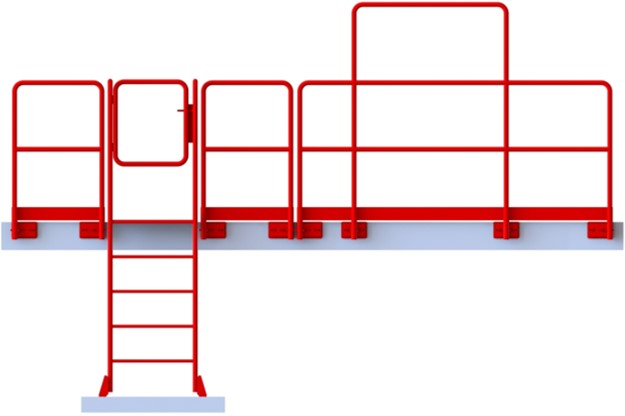
3s safety barriers are protective structures that improve the safety of people moving around a production or warehouse site.
Main types:
- Pedestrian and vehicle access barriers - for collision protection
- Service platform and mezzanine barriers - to prevent falls
- Storage rack barriers - to protect against falling objects.
Applicable standards
- GOST R ISO 12100-2010 (EN 14121) Safety of machinery. Basic principles of design. Risk assessment and reduction.
- DIN EN ISO 14120-2016 Safety of machinery. Protective devices. General requirements for the design and construction of fixed and removable guards.
- GOST R EN 953-2014 (EN 953) Safety of machinery. Protective devices. General requirements for the design and manufacture of fixed and movable devices.
- GOST 12.2.062-81 System of industrial safety standards. Production equipment. Protective barriers
- GOST R ISO 14122-3-2009 (ISO 14122) Safety of machinery. Stationary means of access to machinery. Ladders and handrails
- GOST R ISO 13857-2012 (ISO 13857) Safety of machinery. Safety distances for protection of upper and lower limbs against falling into the danger zone.
- GOST R 51334-99 (EN 294/ISO 13852) Safety of machinery. Safety distances for protection of upper limbs from falling into the danger zone
- GOST 12.2.072-98 (ISO 10218) Industrial robots. Robotic technological complexes. Safety requirements and methods of testing
- GOST R ISO 13855-2006 (EN 999) Safety requirements and test methods.