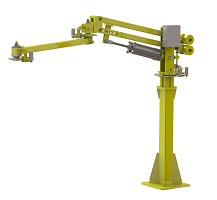
Manipulator SHBM-PP series with pneumatic actuator are automated devices that combine articulated mechanics with pneumatic control. These manipulators enable precise load positioning and simplify manual operations in industrial environments, increasing productivity and workplace safety.
SHBM-PP series pneumatic balanced manipulators are a specialized category of industrial lifting and handling equipment in which lifting and load holding are performed using compressed air energy. This ensures precise positioning and load balancing within the operator’s working area. These solutions are widely used on production lines, assembly stations, logistics centers, and in repetitive operations where ergonomics, safety, smooth movement, and high positioning accuracy are essential.
This equipment complies with current industrial standards and is characterized by high operational performance. It ensures process stability, improves production efficiency, and guarantees consistent task execution with minimal operating costs.
Design and Operating Principle of Articulated Pneumatic Balanced Manipulators
The reliability and performance of the equipment are ensured by its well-engineered design and the quality of its key components. The system represents a complex engineering system consisting of the following main elements:
- Support structure (column or overhead suspension systems) — serves as the base element, absorbing operational loads and ensuring stability during handling operations. Depending on the application, the manipulator can be floor-mounted on a column or suspended from overhead structures.
- Articulated balanced boom system — a multi-joint linkage mechanism designed for load movement in horizontal and vertical planes. The design ensures even load distribution and allows the operator to control movement with minimal physical effort.
- Pneumatic actuator — the main power unit generating lifting force using compressed air. It compensates for the load weight, creating a near-weightless handling effect that is essential for precise and repetitive operations.
- Balancing unit — maintains equilibrium between the boom and the load, ensuring smooth motion, eliminating jerks, and enabling accurate positioning within the working area.
- Control system — can be implemented in various configurations depending on application requirements. Solutions include electro-pneumatic systems with automatic load adaptation, as well as pneumatic systems with manual or fixed balancing adjustment, suitable for both variable and constant loads.
- Gripper device — a replaceable functional element selected according to technical requirements. The standardized interface allows the use of various grippers, including mechanical, vacuum, and pneumatic magnetic types, with quick replacement without modifying the manipulator structure. Pneumatic magnetic grippers ensure secure handling of metal components, while tilting and turning functions are achieved via additional pneumatic actuators.
The system can be additionally equipped with an integrated safety system that prevents uncontrolled movements in emergency situations, such as loss of pressure in pneumatic lines or accidental load release. For floor-mounted configurations, various installation options are available, including fixed mounting or installation on a mobile platform that allows relocation using forklifts. Understanding the interaction of these components allows for an objective assessment of the system’s performance, reliability, and efficiency in industrial applications.
Operating Principle
The system operates using compressed air supplied to a pneumatic cylinder. When activated by the operator via the control system, air pressure is converted into mechanical force that compensates for the load weight. This allows the operator to lift, hold, and move the load with minimal physical effort. The articulated linkage system provides freedom of movement in both vertical and horizontal directions, while the balancing mechanism maintains the load in a stable position. Control can be manual or assisted by precision positioning devices, which is particularly important for assembly and installation operations. The equipment features high control sensitivity and smooth operation. Various configurations are available, such as Articulated pneumatic balanced manipulator SHBM-100-P pro or Pneumatic Balanced Manipulator SHBM-550-PP-R, adapted for different operating conditions and load types.
Applications of Articulated Pneumatic Balanced Manipulators
These manipulators are used across various industries, providing efficient and flexible material handling solutions. The table below outlines key application areas, their characteristics, and typical tasks performed using this equipment.
| Industry | Description | Tasks |
|---|---|---|
| Industrial manufacturing | Used on automated and semi-automated production lines for handling components of various weights |
|
| Mechanical engineering and assembly | Ensures precise handling of heavy, bulky, and complex components during assembly processes |
|
| Logistics and warehousing | Used for internal warehouse operations and order preparation |
|
| Metalworking | Provides safe and precise operations with metal workpieces and products |
|
| Precision manufacturing | Ensures careful handling of sensitive and high-precision components |
|
| Tool and equipment handling | Used for operations involving heavy tools requiring precise positioning and load compensation |
|
The use of such equipment provides a strategic advantage by improving mobility, efficiency, and independence from auxiliary lifting machinery.
Advantages of Articulated Pneumatic Balanced Manipulators
The equipment offers a range of advantages that ensure high efficiency and ease of operation:
- High positioning accuracy with minimal physical effort — the balancing mechanism and responsive control allow precise handling even in complex assembly tasks;
- High cost efficiency — the use of compressed air reduces energy consumption and maintenance costs;
- Ergonomics and reduced operator fatigue — optimized load distribution enables sustained productivity throughout the work shift;
- High versatility — compatibility with various grippers allows adaptation to different products and processes;
- Enhanced safety — integrated safety systems prevent uncontrolled movements and reduce operational risks;
- Reliability and durability — robust design and high-quality components ensure long service life under intensive use.
These features make the system an effective solution for a wide range of industrial tasks while minimizing risks and operational costs.
How to Choose an Articulated Pneumatic Balanced Manipulator
Proper selection directly affects operational efficiency and return on investment. The following parameters should be considered:
- Load capacity — determined by the maximum weight of handled products, including dynamic loads and safety margins;
- Design and configuration — selected based on application type, workload intensity, and environmental conditions;
- Working radius and coverage area — define accessibility of the entire workspace without additional repositioning;
- Gripper type — selected based on product geometry, material, and handling requirements;
- Additional options — positioning systems, safety features, and automation elements improve process control and reduce human error.
Taking these factors into account ensures the optimal selection of equipment that fully meets operational requirements.
Expert Opinion
Researchers I.L. Sandler and D.V. Ivanov, along with PhD A.A. Portnov from Samara State University, in their joint research paper “Information and Measurement System for the Pneumatic Drive of a Specialized Industrial Robot Model MP-11” (2021), note that the use of simulation modeling at the design stage of pneumatic manipulators significantly reduces development time and improves the reliability of equipment operation under real production conditions.
The authors emphasize that the use of specialized software allows early identification of vulnerable elements of the pneumatic system, analysis of transient processes, and optimization of control algorithms without the need for costly physical testing. Based on their findings, the following practical recommendations can be formulated for operators and owners of articulated pneumatic balanced manipulators (SHBM-PP series):
- During operation, particular attention should be paid to maintaining stable parameters of the pneumatic system, as pressure fluctuations directly affect smoothness of movement and positioning accuracy.
- To extend equipment service life, it is recommended to regularly monitor the condition of pneumatic cylinders, flow regulators, and control valves to prevent wear and air leakage.
- When selecting and configuring a manipulator, it is important to consider the nature of motion, load range, and the need for precise control of dynamic processes, especially in repetitive operations.
- To improve safety, it is advisable to use systems that prevent uncontrolled movement of mechanisms in emergency situations or in the event of pneumatic system failures.
Overall, the findings confirm that proper design, configuration, and monitoring of the pneumatic system are key factors ensuring high productivity, reliability, and safety of industrial equipment.
Where to Buy Articulated Pneumatic Balanced Manipulators?
Choosing a reliable manufacturer is essential. High-quality equipment, warranty service, spare parts availability, and customization options are key factors for long-term operation.
Russian Manipulator Company (RMC) specializes in the development and production of Industrial Manipulators, including SHBM-PP series pneumatic balanced manipulators. We offer both standard and customized solutions tailored to customer requirements, ensuring safe, efficient, and reliable material handling.
For detailed consultation and technical information, please visit our Contacts page.