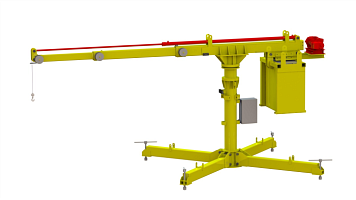
Industrial telescopic manipulators (TM) are high-precision lifting and handling devices designed for operation in confined spaces and at height. Their telescopic design provides an extended working reach and high load capacity while keeping the equipment compact when retracted. TM manipulators are used in construction, logistics, manufacturing, and service operations, improving both operational efficiency and safety.
Telescopic manipulators (TM) are industrial material-handling systems designed for lifting, moving, and positioning loads within an extended working area. The telescopic boom makes it possible to adjust the operating reach according to the layout of the workstation and the requirements of the handling operation. This equipment is used where precise load control, efficient use of workspace, and adaptability to different production tasks are required, including manufacturing, assembly, mechanical engineering, metalworking, warehousing, and equipment maintenance.
Modern telescopic manipulators combine a compact design with an adjustable boom reach and can be equipped with different lifting mechanisms, control systems, installation configurations, and load-handling devices. These features help improve process stability, reduce the physical strain on operators, and increase the efficiency and safety of repetitive material-handling operations.
Design and Operating Principle of Telescopic Manipulators (TM)
The reliability and performance of the equipment are ensured by its well-engineered design and the quality of its main components. A telescopic manipulator is a complex technical system that generally includes the following elements:
- Support structure and installation system — provide stable positioning of the manipulator within the working area. Depending on the model and operating conditions, the equipment can be permanently mounted to the floor, installed on a mobile platform, equipped with folding outriggers, suspended from an overhead structure, or moved along crane runways.
- Telescopic boom — consists of extendable sections that allow the operating reach to be adjusted according to the location of the load and the required handling point. The retractable structure reduces the space occupied by the equipment when the maximum reach is not required and expands the working area without relocating the manipulator.
- Boom rotation mechanism — enables the boom to move around the vertical axis and provides access to different points within the working area. Depending on the configuration, boom rotation can be manual or powered by an electric, electromechanical, hydraulic, or pneumatic drive.
- Lifting mechanism — performs the lifting, lowering, and holding of the load. Depending on the model, the manipulator can be equipped with a cable winch, electromechanical winch, intelligent electric balancer, pneumatic system, or another lifting device selected for the specific application.
- Control system — allows the operator to control lifting, lowering, boom rotation, and other working movements. Control can be performed using a handle, control pendant, push-button station, remote control, or by applying force directly to the load when an intelligent balancing system is used.
- Load-handling device — is selected according to the shape, dimensions, material, weight, and required orientation of the load. The manipulator can be adapted to different production tasks by installing an appropriate mechanical, vacuum, magnetic, or specially designed gripper.
- Safety system — includes limit switches, rotation stops, overload protection, emergency stop devices, load-holding mechanisms, and other protective components required for safe operation.
Understanding the design features and interaction of these components makes it possible to assess the operating potential, reliability, and suitability of a telescopic manipulator for specific industrial tasks.
Operating Principle
The operating principle is based on the coordinated movement of the telescopic boom, rotation mechanism, lifting device, and load-handling attachment. The operator controls the boom reach, lifting height, direction of movement, and load position using the available control devices. The telescopic sections extend or retract to adjust the operating reach, while the lifting mechanism raises, lowers, or holds the load at the required height.
The drive type depends on the manipulator model and its intended application. Telescopic manipulators can use electromechanical, electric, hydraulic, pneumatic, or combined drive systems. Models equipped with an intelligent electric balancer can automatically compensate for the load weight, allowing the operator to move the load with minimal physical effort.
For high-precision operations, the Cable Manipulator with an Intelligent Electric Balancer RMK TM ET-125 can be used. It is designed for lifting and controlled movement of loads weighing up to 125 kg and supports automatic load balancing. Speed and direction can be controlled using a control pendant or by applying force directly to the load.
Coordinated operation of the boom, lifting mechanism, control system, and gripper provides smooth load movement and accurate positioning within the working area while reducing dynamic loads on the equipment and the handled product.
Applications of Telescopic Manipulators (TM)
Telescopic manipulators are used in various industrial sectors where loads must be lifted, moved, held, or positioned within an adjustable working area. The table below presents the main application areas and typical tasks performed using this equipment.
| Industry | Description | Tasks |
|---|---|---|
| Industrial manufacturing | Used to support production processes and move components between workstations, machinery, and assembly areas. |
|
| Mechanical engineering and assembly | Supports assembly and installation operations involving heavy, bulky, or complex-shaped components. |
|
| Metalworking | Provides controlled handling of metal workpieces, sheet material, profiles, and finished products. |
|
| Equipment maintenance | Used when access to a service point requires an adjustable boom reach or when conventional lifting equipment cannot be positioned conveniently. |
|
| Logistics and warehousing | Improves internal material flows and supports handling operations at storage, picking, and dispatch areas. |
|
| Construction and infrastructure | Can be used for controlled lifting and positioning operations when the selected manipulator configuration is suitable for the operating environment. |
|
| Chemical and process industries | Supports the movement of process equipment, containers, and production components in accordance with site-specific safety requirements. |
|
| Food production | Used for handling raw materials, containers, equipment components, and production units where the manipulator and gripper meet sanitary requirements. |
|
| Woodworking | Suitable for moving long, bulky, or packaged wooden products and workpieces. |
|
| Metallurgy | Supports material-handling operations under intensive production conditions when the equipment configuration meets the required load and environmental parameters. |
|
The use of telescopic manipulators helps organize material-handling processes more efficiently, reduce dependence on manual labor, and adapt the working area to different products and technological operations.
Advantages of Telescopic Manipulators (TM)
The equipment offers a range of features that improve operational efficiency, ergonomics, and safety:
- Adjustable operating reach — the telescopic boom allows the distance between the manipulator and the handling point to be changed without relocating the equipment. This expands the working area and improves access to machinery, assembly stations, and restricted zones.
- Precise load positioning — controlled boom movement, lifting mechanisms, and appropriately selected grippers allow loads to be positioned accurately during assembly, installation, and equipment servicing operations.
- Reduced physical strain on the operator — powered lifting mechanisms and balancing systems reduce the effort required to lift, hold, and move heavy or frequently handled loads.
- Adaptability to the workplace layout — depending on the model, the manipulator can be floor-mounted, installed on a mobile platform, equipped with folding outriggers, suspended from an overhead structure, or moved along crane runways.
- Compatibility with different load-handling devices — the gripper can be selected according to the geometry, material, weight, and required orientation of the load, allowing the equipment to be used for different production processes.
- Choice of lifting and drive systems — the range includes models with cable winches, electromechanical winches, intelligent electric balancers, and other drive configurations selected according to the task.
- Improved operational safety — limit switches, rotation stops, overload protection, emergency stop devices, and load-holding mechanisms help reduce the risk of uncontrolled movement and equipment overload.
These advantages make telescopic manipulators a flexible solution for companies that need to improve material handling, reduce operator fatigue, and increase the repeatability of production operations.
How to Choose a Telescopic Manipulator (TM)
Correct equipment selection directly affects operational efficiency, safety, and return on investment. The following parameters should be considered when selecting a telescopic manipulator.
- Load capacity — must correspond to the maximum combined weight of the load and the load-handling device. An appropriate safety margin should also be considered according to the operating conditions and duty cycle.
- Boom reach and vertical travel — determine the size of the working area and the accessibility of the required lifting and positioning points. The selected values should correspond to the layout of the workstation and the movement path of the load.
- Installation configuration — can include permanent floor mounting, a mobile platform, folding outriggers, suspended mounting, or movement along overhead crane runways. The configuration is selected according to the available space, floor condition, and required equipment mobility.
- Lifting and drive system — can be based on an electric or electromechanical winch, intelligent electric balancer, hydraulic, pneumatic, or combined drive. The choice depends on the required load capacity, positioning accuracy, operating speed, and available utilities.
- Load-handling device — is selected according to the dimensions, shape, material, surface condition, center of gravity, and required orientation of the load. A correctly selected gripper ensures secure holding and convenient positioning.
- Control system — may include a control handle, pendant, push-button station, remote control, or direct load control. The selected option should correspond to the required movement accuracy and operator working position.
- Safety and additional options — rotation limiters, overload protection, load-holding devices, mobile platforms, lighting, quick-change gripper systems, and other options can improve safety and simplify integration into the production process.
Careful consideration of these parameters makes it possible to select a model that meets the technical requirements of the operation, the characteristics of the loads, and the layout of the working area.
Expert Opinion
In their 2024 article “Manipulators in Road Construction,” Y. Gurbanov, Senior Lecturer, and students Y. Atajanov and H. Dovranov from the Turkmen State Institute of Architecture and Civil Engineering discuss the classification, applications, and advantages of manipulators used in road construction. The authors note that telescopic manipulators are equipped with extendable booms that provide an increased operating reach and allow the equipment to be used in hard-to-reach areas, including the construction of bridges, overpasses, and other complex engineering structures.
The authors also identify several general advantages of manipulators in road construction that are relevant when assessing telescopic solutions:
- Extended working area — an extendable telescopic boom increases the operating reach and improves access to elevated or difficult-to-reach working points.
- Versatility — manipulators can support different stages of construction and installation work, reducing the need for several types of specialized equipment.
- Reduced labor requirements — mechanized lifting and movement of heavy objects reduce dependence on manual labor and accelerate handling operations.
- Economic efficiency — combining several material-handling functions in one system can reduce the need for additional machinery and optimize operating costs.
- Mobility and adaptability — the ability to adapt the equipment to changing working conditions improves its effectiveness at sites with complex layouts.
- Operational accuracy — the design and control systems support careful load positioning and help reduce the risk of damage to materials and structural elements.
The authors’ overview indicates that telescopic manipulators can provide an extended working area, operational flexibility, and accurate load handling. These qualities are relevant not only to road and infrastructure construction but also to industrial applications where loads must be moved and positioned within a variable working radius.
Where to Buy Telescopic Manipulators (TM)?
Choosing a reliable manufacturer of manipulator equipment is essential for long-term and safe operation. Equipment quality, warranty service, spare-parts availability, technical support, and the ability to adapt the system to specific production tasks should all be considered.
Russian Manipulation Company specializes in the development and manufacture of industrial manipulators, including telescopic manipulators (TM). The equipment is developed with consideration for the intended operating conditions, safety requirements, workplace layout, and characteristics of the handled loads. Standard and customized solutions are available for different production tasks.
The price depends on the load capacity, boom reach, vertical travel, drive and control systems, installation configuration, load-handling device, and required additional options. For detailed advice and technical documentation, please contact the company using any convenient method. Contact details are available on the “Contacts” page.